
Trauma Training Tip
Photo by Serje Lahoud via Pexels
I’ve just completed teaching the 3 modules of the Fire Element – in Silver Spring, MD, Thousand Oaks, CA, and on-line.
The most poignant theme? The powerful impact of shame on the heart. The dynamics between shame and guilt. The importance of bringing our shame into the light of day. The role of relationship in transforming shame. Here’s some of our exploration:
Guilt and shame are about our social contract; they are a social experience and most importantly, repair of their impact occurs in the context of relationship.
Shame focuses on a person, and offers no remedy. It is a tool for social control and can be installed by perpetrators — “Don’t tell anyone about this or I will tell them what a dirty, bad little girl you are.”
Guilt focuses on a behavior, and has a remedy. “When your ball went through the neighbor’s window, it broke. Let’s repair it together – but first I will help you go talk to the neighbor to apologize.” Our ability to hold something we’ve done or failed to do up against who we want to be supports our growth and builds our place in our community. We actually need guilt to grow into the person who we want to be in the context of our community. A person with no capacity for guilt is a psychopath.
In subsistence economies, shame is used to protect the survival of the tribe. People who take more than their share of stored grain endanger the whole tribe’s winter-survival. It can’t be tolerated. This is how shame is part of our social engagement system.
Shame is a powerful approach to social control. It has a profound influence on the Ventral Vagus nerve. It causes a powerful contraction of the heart. If someone can’t learn their culture’s mores, if they can’t inhibit anti-social impulses – they will be shunned – cast out of the tribe and they will not survive alone.
Shame has to be very strong to overcome self-interest. If there is a cupcake for everyone at the party, I have to learn to inhibit my desire for 2 cupcakes! Hopefully our caregiver used this as an opportunity to promote pro-social behavior, inhibit anti-social behavior, and learn impulse control – these are the important lessons around guilt, shame, and belonging.
If we distance ourselves from our client’s shame with our shame, we collude in its contracting, destructive impact – and create even more contraction in our client.
Shame can also be installed by perpetrators. It can be a weapon. This is toxic shame.
Individual perpetrators and governments install shame as a tool of coercion and control.
Racism, sexism, anti-Semitism, Islamaphobia, homophobia, transphobia all create states of contraction rooted in the shame of feeling “toxic” or “wrong”.
BUT!!! Who determines the “mores”? Who decides acceptable expression of emotions, gender, nationality, sexuality, or race?
What is role of white supremacy and patriarchy and capitalism in the use of shame to control culture?
- What about the boy who likes frilly satin underpants?
- Or the girl who climbs trees and plays sports?
- What about the Asian child who’s no good at math, but loves creative writing?
- Or the African American boy or girl who is never allowed to be angry?
- Or the Latino family who so want to belong that they long to eliminate their accent and aren’t sure about teaching their child to speak Spanish?
Don’t let shame reside “in the dark.” Name it, normalize it. Let the light of day clear its contracting impact.
Here’s a clinical suggestion — Hold mingmen — GV 4. It’s at the level of lumbar 2/3, right at the waist and the spinal column. Help your client find their resilience, build capacity, find cardiac coherence. Practice exploring interoception – the sense of knowing ourselves from the inside and neuroception – an embodied experience of safety.
Help liberate them from the contracting power of shame and guilt.
Alaine’s Two Cents
Sharing this heart-felt Instagram post from Tao of Trauma student, Maritza Bollain y Goytia
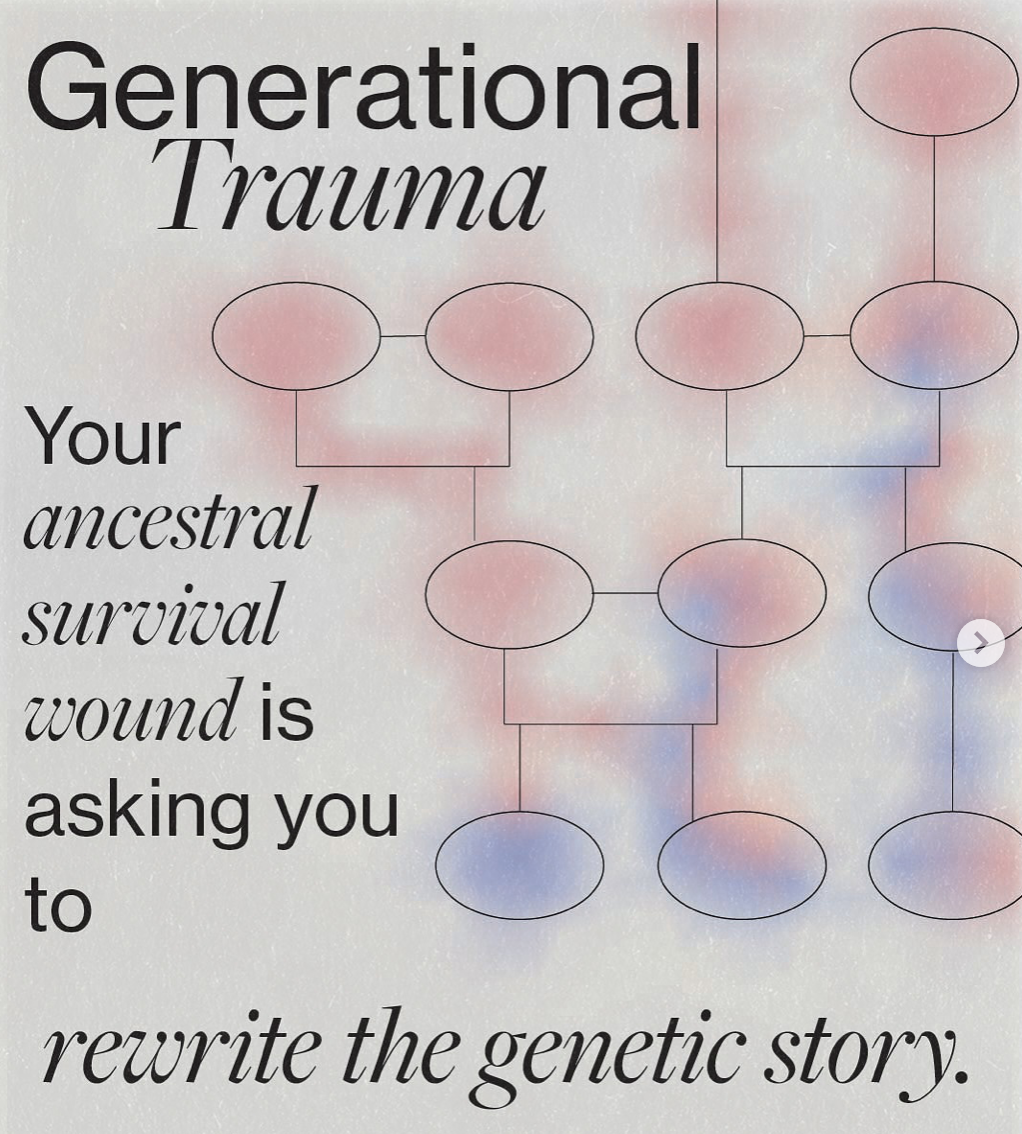
Your Ancestral Survival Wound is asking you to re-write the genetic story.
My family tree isn’t just a family tree.
It’s a map of survival. It’s a nervous system blueprint marked by inherited cortisol spikes, shutdown, over-responsibility, and the quiet ache of never feeling fully safe.
For so many of us—especially those of us who are first-generation children of immigrants—our bodies learned to stay ready.
We never learned how to say “no”. We over-function.
We grind our teeth, clench our jaw, and feel guilty the moment we slow down.
Even in moments of safety, our physiology is still bracing for impact.
This isn’t a personal flaw. This is what epigenetics looks like in real life.
Research shows trauma can imprint itself onto our biology for up to 7 generations. It can alter how our stress-response genes express, how our adrenals regulate cortisol, how our bodies respond to rest.
But here’s the part that moves me every time: Healing can begin in just one generation.
When we regulate our cortisol rhythm, tend to adrenal health, unlearn urgency, and create safety in our own system—we aren’t just healing ourselves. We are interrupting a generational loop.
You will find Maritza in Los Angeles and on Instagram at @dr.maritza.byg
* * * * * * *
And this from Irene Rowland, Tao of Trauma Thousand Oaks Coordinator and Clinical Assistant
Irene has joined a grassroots coalition of Ventura County community members at Ventura County Defense. . VCDefense seeks to “Empower Immigrants in Ventura County with Trusted Resources, Guidance, and Community Support.” Irene says she “helps patrol neighborhoods — trying to intervene with ICE agents when we find them, conduct outreach informing the immigrant community of their rights, and provide resources. Being in community with like-minded individuals help me navigate the challenges of these times. It feels better to be doing something. The global conflict seems like an extension of the local strife and it’s the same greedy hate engine that drives it all. So I try to remember that change and transformation are inherent in the way of things and beyond the rubble is light.”
You will find Irene in Thousand Oaks, CA and on Instagram at @irenes.rowland
Check This Out!
The 2025-26 Tao of Trauma – Now taking registrations for this year-long, 5-session series, being offered in Hamilton Township, NJ and Silver Spring, MD. Early bird deadline August 15, 2025. Space is limited!
Click here for info and to register
Here’s an introduction to the Tao of trauma on the Soulthentic Podcast. It’s a dialogue with Alaine Duncan and Tracey Post – co-faciltators of the 2025-26 version of The Tao of Trauma.
Healing Trauma Through the Body’s Wisdom – a Soulthentic Podcast with Linh Le
https://open.spotify.com/episode/0woCEmEVPlT0ngn1PYEKBl
In this Soulthentic Podcast episode, I’m joined by Alaine Duncan, acupuncturist and author of The Tao of Trauma, and Tracey Post, LCSW and CEO of the Princeton Center for Mindbody Healing. Together, they are co-facilitating the next 2025-2026 Tao of Trauma training—an approach that integrates the neurobiology of traumatic stress with Chinese medicine.
In this episode, we explore how this East-meets-West framework offers a unique path for trauma healing—one that honors both the nervous system and the body’s deep intelligence. Alaine and Tracey share how trauma is not just a memory stored in the mind but a physiological and energetic imprint held in the body and how practitioners across fields can learn to safely and skillfully support its resolution.
Whether you’re an acupuncturist, massage therapist, mental health practitioner, or medical provider, this episode will inspire you to look at trauma through a multidimensional lens—and maybe even join the next Tao of Trauma training cohort starting in September 2025.
Clinical Curiosity
Where is your clinical curiosity carrying you?
Send me a question or two and I will explore them with readers in this corner next month.
Q.
My patient is in her 40’s. She’s quite shy and just about never asserts herself. I’m not a mental health clinician, but I’d say she’s very sad – even depressed. Her Dad was very authoritarian, a real rigid “my way or the highway” kind of guy. It just seems like she can’t find herself and flourish on her own terms. I think she’s a Fire survival type. I’m a bodyworker.
A:
So glad she has you! It sounds like she would benefit from exploring the “May I touch you” exercise – from the perspective of both cultivating interoception, and exploring her sense of vulnerability.
When you ask “May I touch you” – talk to her pericardium. The pericardium, or “heart protector’s” job is to be a pair of gates that open when the heart feels safe and stays shut when it isn’t safe. It’s important for us to know when it’s safe to open our heart – it’s the best way to cultivate our Ventral Vagus nerve.
Our Ventral Vagus is the most important brake on our Sympathetic Nervous System, which has no social intelligence on its own. It supports our capacity for compassion, empathy, our curiosity, and our delight in life. It nourishes the heart – which plays a central role in beating out the rhythm of our life. When our heart is flourishing, all the organs and systems of our body work in harmony with each other and feel supported. It sounds like there wasn’t much permission for a “no” in her family of origin, so this could be very important for her in finding her own truth.
If we can’t say no – we can’t say yes!