
Integrative Healing partners with The Princeton Center for MindBody Healing for the 2025-26 version of The Tao of Trauma!

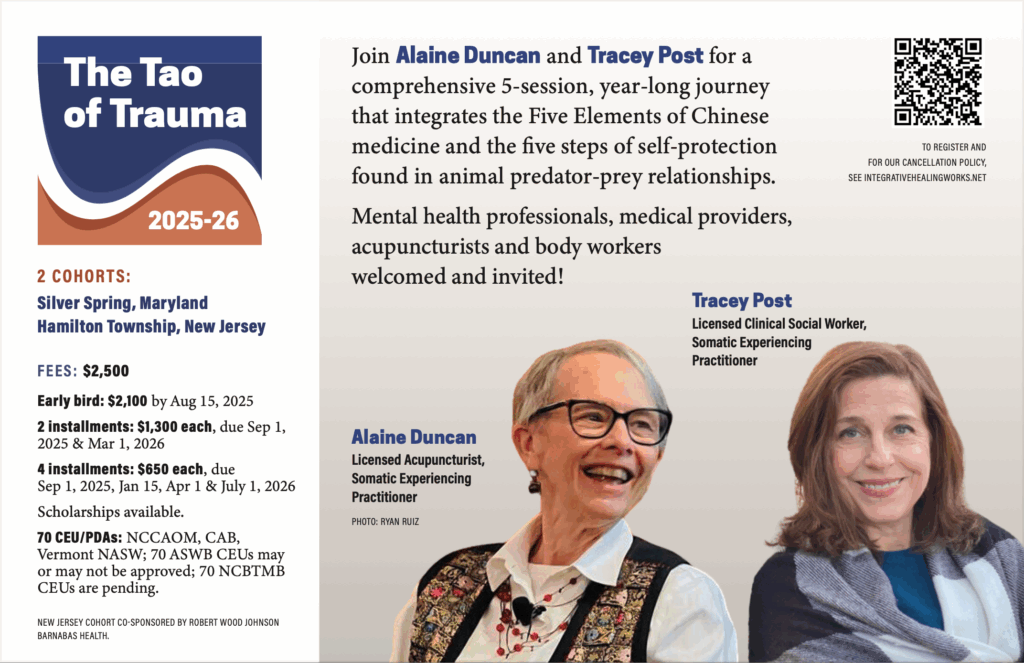
Join Licensed Acupuncturist and Somatic Experiencing Practitioner Alaine Duncan and Licensed Clinical Social Worker and Somatic Experiencing Practitioner Tracey Post for a 5-session, year-long exploration of an East meets West approach to restoring balance and regulation in survivors of traumatic stress.
- Follow the 5 Elements and the 5 Seasons of the Chinese agricultural calendar — and their interface with self-protective responses found in animal predator-prey relationships and described in western neuroscience in general and PolyVagal Theory in particular.
- Be amazed at the innovative approaches to support balance and regulation in trauma survivors that emerge out of this East meets West approach.
- Receive in-depth didactic and hands-on instruction and practice to help trauma survivors complete missing or thwarted steps in the Self-Protective Response.
- Mental health professionals, medical providers, acupuncturists, and body workers welcome and invited!
Central to The Tao of Trauma classes are the supervised clinical practice sessions in each module. Students “lend” their nervous system/energy body to fellow classmates to explore and practice the interaction, observation, and touch skills inherent in The Tao of Trauma model.
Dyadic practice merges cognitive learning with body wisdom, cultivates deeper somatic awareness in the therapeutic experience of both practitioner and client — and builds the fabric of the class. They are the heart and soul of the classroom model.
The full training schedule can be viewed HERE.
Introduction
Here’s an introduction to the Tao of Trauma on the Soulthentic Podcast. It’s a dialogue with Alaine Duncan and Tracey Post – co-faciltators of the 2025-26 version of The Tao of Trauma.
CEUs
70 NASW / ASWB CEUs: Approved for 70 CEUs through NASW Vermont; application for ASWB credits may or may not be approved.
- Course completion requirements: Social workers must attend the entire course and complete a course evaluation to be eligible for CE credit. Certificates of completion will be emailed within 10 business days of course completion.
70 CAB CEUs: Category 1 Course by the California Acupuncture Board, Provider number 1576, for 5 weekends of 14 hours each weekend of live in person continuing education.
70 NCCAOM PDAs: 14 hours per module approved by the National Certification Commission for Acupuncture and Oriental Medicine.
70 NCBTMB CEUs: 14 hours per module approved by the National Certification Board for Therapeutic Massage & Bodywork.
Full Course Description
Click to show detail
The Tao of Trauma: Integrating Five Element Theory and Trauma Healing is rooted in an East-meets-West approach to restoring balance and regulation in survivors of traumatic stress. It marries theoretical and clinical concepts from Western neuroscience with Chinese Medicine (CM) to elucidate mind and body based clinical skills for psychotherapists, acupuncturists, and physical care and medical providers.
The Self Protective Response, defined by Peter Levine, founder of the Somatic Experiencing model of trauma resolution, mirrors the movement of the Five Elements, defined by CM. This interface provides a framework for deepening clinical applications of Stephen Porges’ Polyvagal theory. This integrative approach gives rise to a framework for understanding five “survivor types” and ways to access the incomplete survival impulses wreaking havoc in an individual survivor’s body, mind, emotions and spirit.
This ancient and modern integrative lens illuminates the diverse manifestations of traumatic stress in its survivors – chronic pain, mental health disorders, autoimmune illness, insomnia, and metabolic problems – and provides clues to understanding and transforming the clinical and social impact of unresolved trauma in our homes, with our patients, and on the streets.
Summarizing main points of workshop
Understanding these correspondences alongside the study of the autonomic nervous system can guide clinicians to more nuancedwhole-person approaches to understanding and treating the dysregulation caused by traumatic stress, including mental health disorders, chronic pain, autoimmune illness, insomnia, and metabolic problems. This ancient/modern, East meets West integrative approach enriches the clinical applications of diverse providers and brings new hope to survivors of trauma.
Survivors are genetically predisposed to both react and recover from the impact of overwhelming traumatic stress. The Traumatic Stress Response is not a life-sentence.
CM Yin/Yang theory mirrors the concepts of sympathetic activation and parasympathetic collapse in the autonomic nervous system. Similarly, the steps of the Self-Protective Response defined by neurobiology are mirrored in CM’s Five Phase theory.
Symptoms survivors of traumatic stress present with can be understood as expressions of their success or failure in completing one or more steps of their Self Protective Response.
The Polyvagal theory provides a useful theoretical construct for understanding the impact of developmental trauma on the enteric brain and its impact on adult morbidity and mortality.
The core principles of treatment for the spectrum of Traumatic Stress Responses and traumatic brain injury, include evaluating arousal and collapse, pacing, titration, enhancing body-based and emotional mindfulness and integration of treatment.
The metaphors and correspondences of the Five Phase model of CM are a useful construct for working with cognitive function, emotional wellbeing, body systems and tissues, and spiritual longings in trauma survivors for diverse providers.
Course Learning Objectives
Click to show detail
At the conclusion of this Workshop series, learners will be able to:
- Assess survivors’ Traumatic Stress Response as an expression of success or failure in one or more steps of their Self Protective Response.
- Apply yin/yang theory to the concepts of sympathetic activation and parasympathetic collapse after traumatic stress.
- Summarize elements of traumatic stress as an energetic (qi) system that has been stimulated beyond its range of resiliency and is awaiting restoration of its natural balance and equilibrium.
- Name core principles of treatment for the spectrum of Traumatic Stress Responses and traumatic brain injury, including evaluating arousal and collapse, pacing, titration, enhancing interoceptive mindfulness and integration of treatment.
- Demonstrate and practice regulation skills that help trauma survivors restore balance in the brace and/or collapse response in their body, mind, emotions and spirit after traumatic stress.
- Identify factors that contribute to the definition of a practitioner’s scope of practice
- Discriminate between signs of activation in the nervous system and those of relaxation
- Summarize elements of the poly-vagal system and list the critical role of developmental trauma on the enteric brain in adult morbidity and mortality as a public health concern.
- Identify the clinical usefulness of using the metaphors of the Five Phase model of Chinese Medicine for working with mental health disorders, body systems and tissues, cognitive function, emotional wellbeing, and spiritual longings.
In addition to the above, at the conclusion of the Awakening Arousal module, participants will be able to:
- Demonstrate skill in conscious and respectful interactions with trauma survivors.
- Demonstrate ability to monitor client activation via a combination of verbal tracking of a client’s felt sense and tactile awareness.
- Name the primary and secondary diaphragms.
- Summarize the ways in which the body diaphragms interact as resonant structures.
- Demonstrate skill in restoring balance and regulation to the brace/collapse response in the diaphragm system and its impact on the body, mind, emotions and spirit after traumatic stress.
- Summarize the “personality” of the Lung in CM.
- Summarize the “personality” of the Colon in CM.
- Demonstrate skill in using the Felt Sense to restore interoceptive awareness.
At the conclusion of the Signaling Threat module, participants will be able to:
- Demonstrate skill in helping trauma survivors cultivate interoceptive mindful approaches to the creation of safe boundaries.
- Demonstrate and practice regulation skills to restore capacity in the signaling function of the kidney/adrenal system after traumatic stress.
- Summarize the poly-vagal system and the critical role of the Kidney-Heart axis in traumatic stress.
- Apply the concepts of titration and pendulation between a resourced state and an activated state via interoceptive capacity building and visual observation.
- Summarize the personality of the Kidney in CM.
- Summarize the “personality” of the Bladder in CM.
- Describe the relationship between the “Brain” as understood in CM and the brain stem as understood by neurophysiology.
- Demonstrate techniques for restoring regulation in the Kidney/Adrenal system.
In addition to the above, at the conclusion of the Mobilizing A Response module, participants will be able to:
- Demonstrate and practice regulation skills to restore the orienting response in trauma survivors.
- Demonstrate skills in slowing down, tracking and cultivating interoceptive mindfulness of the mobilization response of fight or flight in trauma survivors.
- Demonstrate and practice regulation skills to restore regulation in the autonomic nervous system and in the joints to address chronic pain patterns in survivors of trauma.
- Summarize the ways in which the five senses provide support for orientation and self-protection in trauma.
- Analyze the concepts of pain as a phenomenon of qi/energy becoming depleted, stuck, or disorganized due to injury, illness, or environmental exposure.
- Analyze the influence building, moving, or bringing order to the qi/energy body may have on chronic pain.
- Identify the interface of the Elements of CM and the autonomic nervous system in survivors of trauma.
- Summarize “the personality” of the Liver and Gall Bladder and their role in the mobilization of the fight/flight response from an integrative, East-West perspective.
- Demonstrate and practice regulation skills designed to restore capacity to successfully orient to threat.
- Summarize the importance of slowing down, tracking and cultivating interoceptive mindfulness of the mobilization response.
- Demonstrate and practice regulation skills to restore the joints and to address chronic pain patterns in physical injury survivors.
- Summarize dynamics of proprioception and kinesthetic sense after traumatic injury. Develop skills in restoring the self-protective response after injury.
In addition to the above, at the conclusion of the Restoring Coherence module, participants will be able to:
- Demonstrate an understanding of the poly-vagal system and the critical role of the kidney/heart axis in trauma survivors.
- Demonstrate and practice regulation skills to restore capacity for social engagement after trauma.
- Name the primary functions of fascia.
- Demonstrate clinical skills in working with the mediastinum.
- Summarize methods through which clients can be supported in the development of the capacity to differentiate without fragmenting.
- Summarize methods through which clients can be supported in developing the capacity to unify or make healthy connections without constricting.
- Demonstrate and practice regulation skills to support the relationship between connection and individuation as expressed in the fascia system and the Triple Heater meridian.
- Summarize the “personality” of the Heart in CM.
- Summarize the “personality” of the Pericardium in CM.
- Summarize the “personality” of the Small Intestine in CM.
- Summarize the “personality” of the Triple Heater in CM.
- Discriminate between the “Mind” as understood in CM and the frontal cortex as understood by neurophysiology.
In addition to the above, at the conclusion of the Digesting the Gristle module, participants will be able to:
- Observe and demonstrate regulation skills to augment treatment, access subtle expressions of dysregulation and bring healing to trauma survivors.
- Demonstrate and practice regulation skills to help restore balance and regulation in the competing impulses of “standing my ground” or “fighting/fleeing” in the body, mind, emotions and spirit of trauma survivors.
- Apply polyvagal theory in interaction to help restore balance and regulation in the enteric brain in survivors of trauma.
- Describe common physiological responses to stress which affect the digestive system
- Describe the polyvagal theory concepts that name how early trauma can contribute to physiological dysregulation.
- Demonstrate an understanding of the role of the enteric or visceral brain in the neurophysiology of Adverse Childhood Events, and their impact on adult morbidity and mortality.
- Summarize the interface of the Five Elements of CM and the autonomic nervous system in survivors of trauma.
- Summarize the “personality” of the Spleen and Stomach and their role in digesting life experiences and harvesting lessons from an integrative, East-West perspective.
- Identify the science of the poly-vagal nervous system and how it helps explain the life-long impact of early trauma on the viscera and the enteric brain.
- Summarize the impact of Adverse Childhood Experiences as an underlying feature in virtually every public health question of morbidity and mortality

Registration Options
Our 2025-26 season will include two in person cohorts: One in Silver Spring, Maryland and another in Hamilton Township, New Jersey.
Registration for the full series is now closed.
REPEATERS OPTION: Returning students who would like to repeat an individual module are welcome on a space-available basis at a discounted rate. Please email us at registrar @ integrativehealingworks.net to inquire about space/availability for the module you are interested in attending.
#1: In Person in Silver Spring, Maryland
Crossings Healing and Wellness
8720 Georgia Avenue, Suite 300
Silver Spring, MD 20910
| MODULE | CLASSES HELD: Friday/Saturday 9:30 a.m. – 6:00 p.m. Eastern Time – |
| Metal | Awaken Arousal | October 3 & 4, 2025 |
| Water | Signal Threat | January 9 & 10, 2026 |
| Wood | Mobilize a Response | March 20 & 21, 2026 |
| Fire | Restore Coherence | May 29 & 30, 2026 |
| Earth | Digest the Gristle | September 18 & 19, 2026 |
#2: In Person in Hamilton Township, New Jersey
Robert Wood Johnson Fitness and Wellness Center
3100 Quakerbridge Rd.
Hamilton Township, NJ 08619
| MODULE | CLASSES HELD: Friday/Saturday 9:30 a.m. – 6:00 p.m. Eastern Time – |
| Metal | Awaken Arousal | September 26 & 27, 2025 |
| Water | Signal Threat | November 21 & 22, 2025 |
| Wood | Mobilize a Response | March 6 & 7, 2026 |
| Fire | Restore Coherence | May 15 & 16, 2026 |
| Earth | Digest the Gristle | August 14 & 15, 2026 |
Fee Schedule
| Payment Due Dates | ||
|---|---|---|
| Early Bird | $2,100 | Paid in full on or before August 15, 2025 |
| Single payment | $2,500 | after August 15, 2025 |
| Two Payments | $1,300 each | September 1, 2025 and March 1, 2026 |
| Four Payments | $650 each | September 1, 2025; January 15, 2026; April 1, 2026; and July 1, 2026 |
Scholarships available.
Payment and Cancellation Policy
If you registered as part of a payment plan, please note the dates for each of your payments. We do not store your credit card information and can’t make charges ourselves, so you are responsible for making those payments.
Cancellations made 30 days prior to class will receive full refund, less $100 administrative fee. Students who cancel their registration after the Final Payment deadline will NOT receive a refund of any amount.
Participants have the option of rescheduling their attendance for up to one year for any particular module.
It is important to attend the full training for the optimum learning experience. If you must leave for any length of time during the training, please inform the registrar, an assistant, or the instructor.
Invitations to join a class from the waiting list will be sent via email when space becomes available.
Students who are registered for a class will receive email reminders with hand-outs 10 days before class. Students are responsible for checking their email, including spam folders, for these reminders and notifications.
Questions or Comments?
Please contact Alaine Duncan at alaine.duncan@integrativehealingworks.net or Tracey Post at tracey@princetonmindbody.com if you have questions, concerns, any ADA accommodations or grievances about this course.
About Tracey & Alaine
Tracey Post, LCSW, SEP
Over 20 years of experience in trauma, post-traumatic growth, sexual health, and sexual identity. Expertise in Somatic Experiencing, multi-sensory trauma treatment, EMDR, women’s sexuality, gender identity, diverse sexual expression, and sexual orientation. Tracey is a nationally recognized speaker and consultant on topics including trauma, multi-sensory mindfulness and post-traumatic growth. More at https://princetonmindbody.com/clinicians-coaches#Tracey_Post
Alaine Duncan, M.Ac., L.Ac., Dipl.Ac, SEP
Alaine Duncan is a Somatic Experiencing Practitioner and an acupuncturist who integrates the neurobiology of traumatic stress with the wisdom of Chinese medicine. She holds a particular fascination for how restoring balance and regulation in trauma survivors serves both individual healing and social transformation. Her book, The Tao of Trauma: A Practitioner’s Guide for Integrating Five Element Theory and Trauma Treatment, is the foundation of East-meets-West workshops she offers for acupuncturists, mental health and medical providers.
Target Audience
Licensed Acupuncturists, Social Workers, MFTs, Counselors, Occupational Therapists, Nurses, Holistic Nurses, Physical Therapists, Massage Therapists and BodyWorkers, Physicians, Psychologists, Naturopathic Physicians.
Rave Reviews from Graduates of The Tao of Trauma
Thoughts from 2024-25 Students, in their own words:
“Truly one of the best continuing education courses I have taken in years. Alaine’s has put together a masterful and elegant class combining lecture, demonstration and practice in a way that feels immediately accessible and seamless. I can hardly wait for the next module!”
“I can really feel the connective space that has been created. It permeates in every aspect of the training and is a wonderful reminder that how we show up in our work (and day to day lives) is often MORE impactful than the skills or knowledge we bring. It has been such a delightful experience to observe and participate in a group that is so thoughtfully curated in this way. I already feel myself shifting how I show up in my life and how I approach the spaces I’m in.”
“One of the most useful CEU courses I have taken (we’re talking 30 years of CEU courses too). Alaine is so generous with her knowledge and highly skilled in how to teach and guide and support us in learning and exploring. I have several new clients who have immediately benefitted from what I have been learning in ToT.”
“I am so grateful for this work as it has solidified my own belief in touch/table work with trauma survivors. I am building confidence in working with people’s bodies as a psychotherapist and this training has contributed greatly to this journey.”
“Always in awe of this work. Thanks for teaching us, not only what’s in the material but also by your way of teaching, holding space for everyone. Gratitude.”
“Every time I hear this information, my understanding deepens. It always provides me the reminder of how everything is tied to our nervous system, and if we can ensure that the nervous system is flowing smoothly between sympathetic and parasympathetic responses, our clients’ bodies will heal themselves.”
“I’m grateful to be in a class with mixed backgrounds and clinical practice. It’s a great reminder to approach concepts that may not feel new with fresh eyes. I appreciated the moments to practice and really embody what it feels like to approach trauma care in this way. I’ve already used some of the techniques we practiced with patients this week.”
“I appreciate the pacing of the class. It’s congruent with the titration/ pacing of applying this work with patients.”
“I want to say again and again how helpful it was to have so many assistants so that they could work with a small number of groups and really attend to each dyad. Thank you for that!”
“I continue to think about Tao of Trauma teachings and historical implications that have traveled through generations, family, personally/individually and through cultures. I continue to imagine how to integrate this healing individually and communally. Communal trauma requires communal healing. I was also reminded about the importance of the pause this fire module. It is so significant always especially in these times and for bodies of culture. Our bodies are often required to override trauma/stress to survive and assimilate to the pace of the dominant culture. Thank you!”
“I appreciated the moments to practice and really embody what it feels like to approach trauma care in this way. I’ve already used some of the techniques we practiced with patients this week.”
“As always, the content from the weekend was immediately applicable with patients on Monday. I continue to be grateful for the skills and groundedness that this course provides.”
“The adrenal hold and brainstem hold have been very useful during this time of upheaval – between the fires and the inauguration there has been so much uncertainty and trauma! Alaine has done such a marvelous job of organizing and presenting this material.”
“It gives me more tools on helping clients increase their ability to tolerate difficult emotions.”
“Amazing course. Thank you for sharing your gifts. I am very excited to continue to use Tao of Trauma in my work with clients.”
“Mind blowing, as usual. So grateful for this knowledge and wisdom.”
“Wonderful course, so enriching and heartwarming each and every module.”
“Alaine Duncan is SUPREMELY skilled at facilitating, what a wonderful, heart-centered of a human being she is!!! I am full of gratitude at having learned of this opportunity to study with her.”
“This material continues to enhance my practice by providing me with more tools to be present and grounding for my patients.”
“It is a pleasure attending each module of the Tao of Trauma. This is a gem of a course!”
More on Each Module
METAL. The Self-Protective Response begins and ends with somatic awareness, supported by the Metal Element.
Embodying successful survival leaves our interoceptive system available to provide clear and unencumbered information to awaken arousal to future risks.
Practice cultivating somatic mindfulness, touching the skin as a boundary organ, and restoring regulation in the diaphragms after global arousal.
More info: ToT-Autumn
WATER. The whole body is alarmed when the Water Element signals threat.
Explore the Kidney/Heart axis, the Polyvagal System, the impact of consuming fear on morbidity, mortality, and the inter-generational impact of traumatic stress.
Learn skills to restore a sense of safe container, build capacity in the Kidney/adrenal system, and re-establish regulation in the brain stem.
More info: ToT-Winter
WOOD. The Wood Element mediates our fight or flight response.
Thwarted mobilization can result in chronic pain, lack of embodied awareness and challenges in orienting to safety and danger.
Learn skills to support proprioception in the sinews, capacity to orient to threats, and a return to benevolence in the Liver Blood.
More info: ToT-Spring
FIRE. The Fire Element functions of relationship, connection and coherence are deeply impacted by trauma.
Profound vulnerability and shame require nuanced approaches to restore the Kidney/Heart axis, the pericardium’s capacity for connection, the Triple Burner’s infrastructure for connection and the Heart spirit’s gift of coherence, propriety and regulation.
Learn skills to restore the infrastructure and capacity for connection and whole-body regulation.
More info: ToT-Summer
EARTH. The Earth Element is vulnerable to freeze/shutdown in trauma.
Explore the visceral brain and the impact of pre and peri-natal trauma on adult morbidity and mortality and community health.
Learn ways to help move memories out of muscle tissue, support restoration of the gut biome, help patients digest food and experiences, and find stability.
More info: ToT-LateSummer